Vol. 31 No. 52 (2026): Revista Punto Cero No. 52
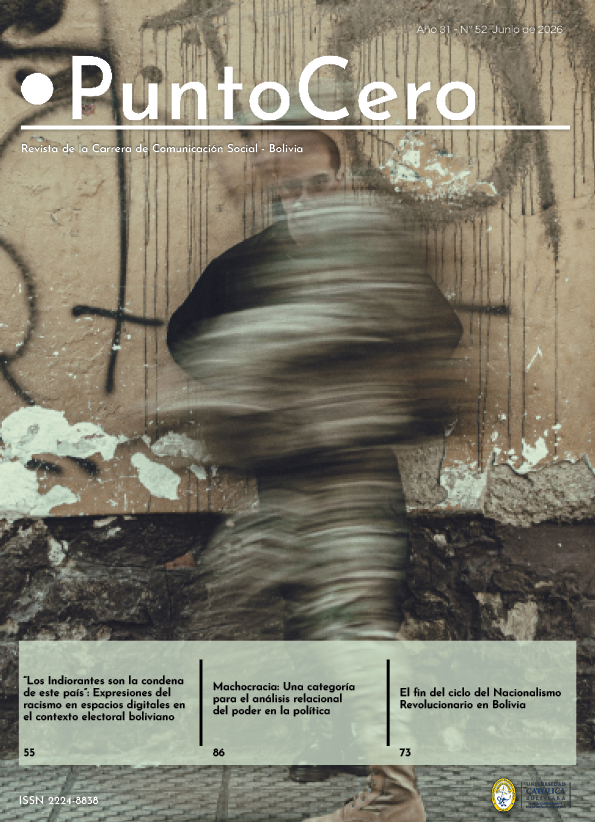
Portada_n52

In this new issue, Punto Cero addresses the contemporary debate on the intricate relationship between communication and politics. The studies analyze the identity and digital coordination of the MAS "Guerreros Samurai" through Telegram and WhatsApp; the discursive polyphony of the Paz-Lara ticket in the 2025 Bolivian elections drawing on Bakhtin's theory; and a critical reading of textbooks in Mexico and Spain as instruments of political legitimation rather than civic pedagogy. The issue also examines expressions of racism in digital spaces based on Facebook comments; posits the end of the Revolutionary Nationalism cycle in Bolivia and the transition toward a new citizen-democratic State; investigates "machocracia" as a relational system of power through the discourse analysis of María Galindo; and proposes methodological guidelines for a hermeneutics of the narrative of power aimed at deconstructing the communicational strategies of legitimation and social domination.

Published: 2026-06-30
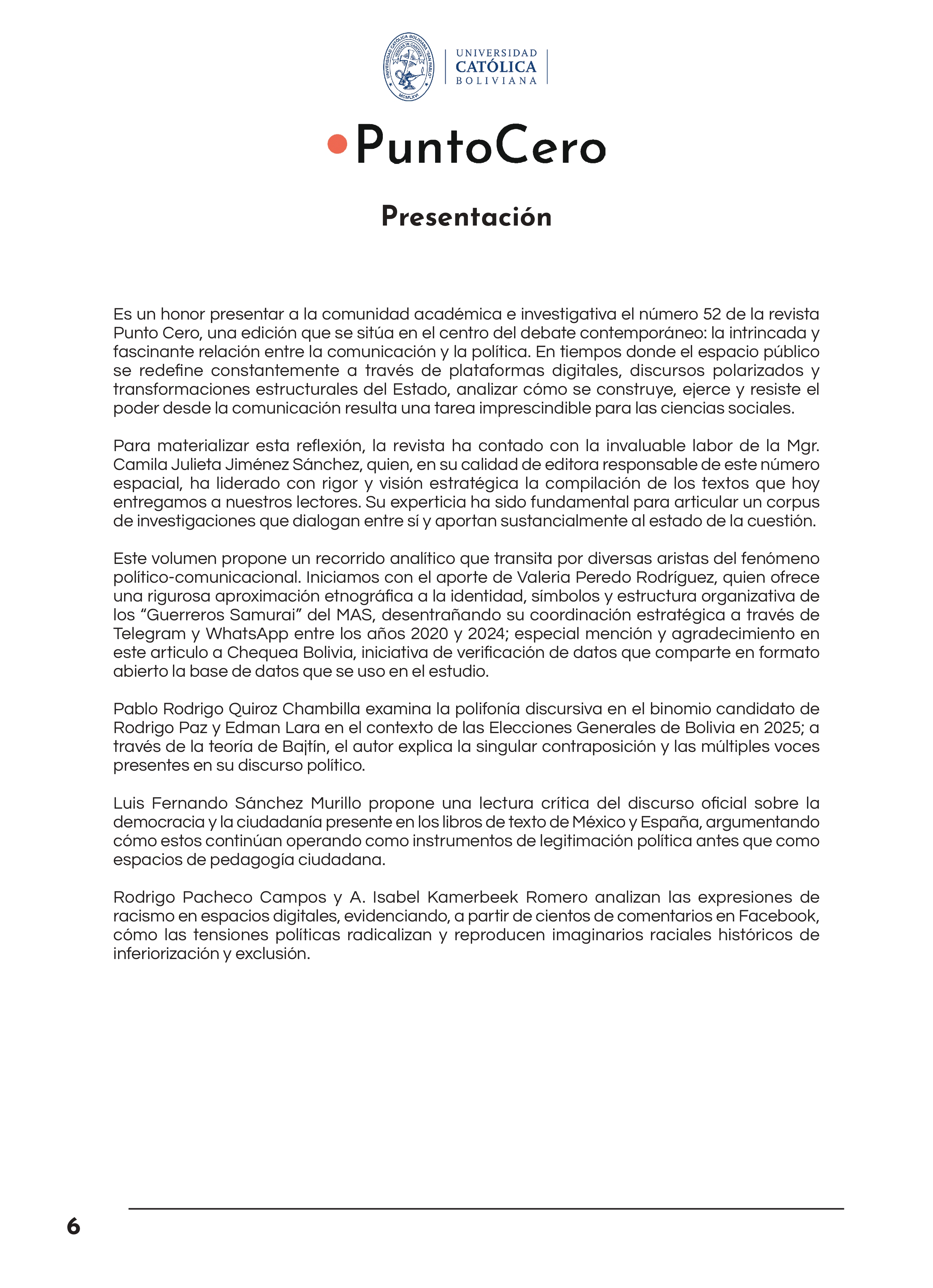
Presentation

Articles

  • Identity, Organization, and Political Agendas on Telegram and WhatsApp: The Case of the MAS Samurai Digital Warriors (2020–2024)

    Valeria Peredo Rodríguez
    8-25
    DOI: https://doi.org/10.35319/puntocero.202652518
  • Discursive Polyphony in the Rodrigo Paz and Edman Lara Ticket Ahead of Bolivia's 2025 General Elections

    Pablo Rodrigo Quiroz Chambilla
    27-40
    DOI: https://doi.org/10.35319/puntocero.202652519
  • Educational Discourse on Democracy in Mexico and Spain: A Comparative Reading of Textbooks

    Luis Fernando Sánchez Murillo
    42-53
    DOI: https://doi.org/10.35319/puntocero.202652520
  • "The Indiorantes Are the Curse of This Country": Expressions of Racism in Digital Spaces in the Bolivian Electoral Context

    Rodrigo Pacheco Campos, A. Isabel Kamerbeek Romero
    55-71
    DOI: https://doi.org/10.35319/puntocero.202652521
  • The End of the Cycle of Revolutionary Nationalism in Bolivia

    Renzo Carlo Abruzzese A.
    73-84
    DOI: https://doi.org/10.35319/puntocero.202652522
  • Machocracia: A category for the relational analysis of power in politics

    Tania Valeria Lujan Rivero, Camila Jiménez Sánchez
    86-99
    DOI: https://doi.org/10.35319/puntocero.202652523
  • Hermeneutics to interpret the narrative and discourse of/from power

    Yuri F. Tórrez
    101-113
    DOI: https://doi.org/10.35319/puntocero.202652524